
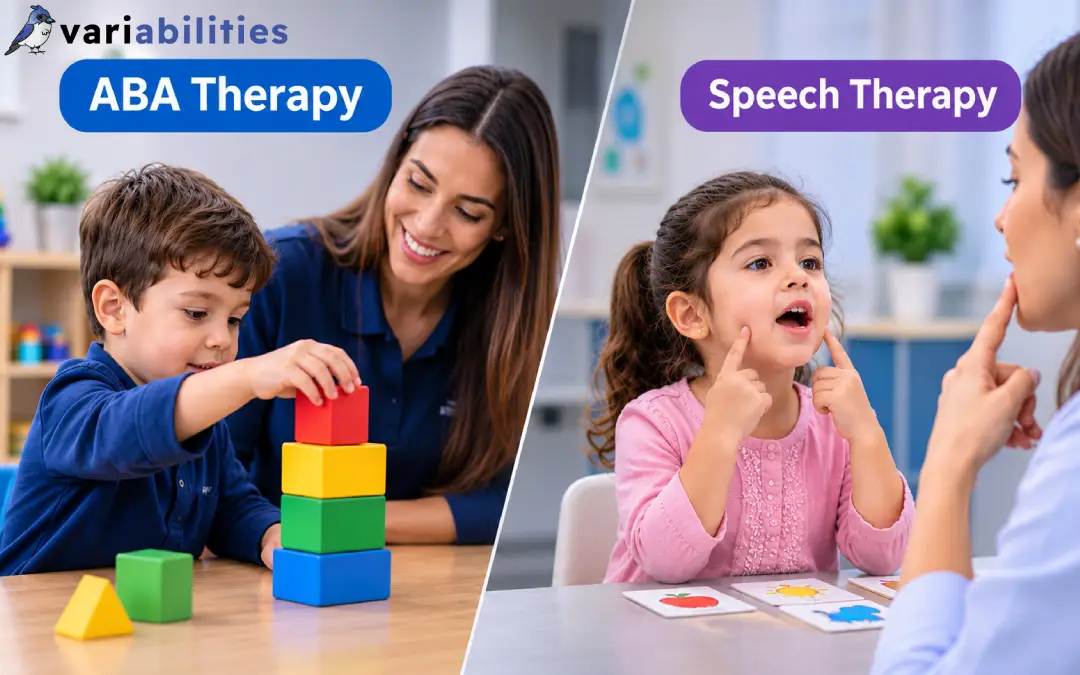
When your child receives a diagnosis or experiences developmental delays, navigating the different therapy recommendations can feel overwhelming. You may hear both Applied Behavior Analysis (ABA) and speech therapy recommended and wonder how they differ or whether your child could benefit from both. While these therapies serve distinct purposes, they often complement one another in supporting your child's development.
At Variabilities, a clinician-owned, in-home ABA practice serving Collin, Denton, and Grayson Counties, we recognize that every child's developmental journey is unique. We believe in empowering families with the knowledge and resources they need to make informed decisions about their child's care. If you are new to ABA, we invite you to explore our page on What Is ABA Therapy? to learn more.
This article is designed to help families better understand the differences between ABA and speech therapy, how these services can work together, and their respective roles in supporting meaningful development. We encourage families to collaborate with their child's pediatrician and clinical team to determine which services best align with their child's individual strengths, needs, and family priorities.
What Speech Therapy Focuses On
Speech therapy is provided by a speech-language pathologist, often called an SLP. According to the American Speech-Language-Hearing Association, SLPs play a central role in screening, assessing and treating autism, and focus on areas such as understanding and using language, social communication, speech production, augmentative and alternative communication (AAC), and feeding and swallowing. For a child, that might mean working on forming sounds, building vocabulary, following directions, or learning how to take turns in a conversation. If a child does not use spoken words, an SLP can also help explore other ways to communicate, such as pictures, gestures or a speech-generating device. SLPs also help evaluate communication to tell apart different needs, since not every child with a social communication difficulty has autism.
What ABA Therapy Focuses On
Applied Behavior Analysis, oftentimes known as ABA, uses principles of learning to teach skills and support behavior change. ABA is usually designed and overseen by a board certified behavior analyst, or BCBA, and sessions are often delivered by trained technicians. Insurers describe ABA goals in broad categories. Aetna's published guide, for example, groups needs into maladaptive behavior, social communication and self-care. So an ABA program might target things like following routines, handling transitions, using words or gestures to ask for what a child wants, toilet training, or reducing behaviors that get in the way of daily life. Each program starts with an assessment, and the goals are written around the individual child.
Where the Two Overlap
ABA therapy and speech therapy share a common goal of helping children develop meaningful skills that support communication, independence, and participation in everyday life. While each discipline brings its own specialized expertise, their approaches can complement one another.
A speech-language pathologist (SLP) specializes in speech and language development, social communication, augmentative and alternative communication (AAC), and feeding. ABA professionals can complement these efforts by creating meaningful opportunities for children to practice and generalize communication skills across daily routines, activities, and environments.
For example, an SLP may help identify the most appropriate communication system for a child, while the ABA team can collaborate with the SLP to incorporate that system into everyday activities, such as requesting a preferred snack, expressing a need for a break, or engaging in play with others.
At Variabilities, we value interdisciplinary collaboration and recognize the unique expertise each professional brings to a child's care. By working together with speech-language pathologists, caregivers, and other members of a child's support team, we can promote consistency across environments and create more opportunities for meaningful, functional communication. Rather than viewing these therapies as competing services, we believe they can work together to support the whole child.
ABA Therapy at Home With Variabilities
At Variabilities, we provide individualized, BCBA-led, in-home ABA therapy for families across Collin, Denton, and Grayson Counties. Our family-centered approach allows children to develop meaningful skills within familiar environments, creating natural opportunities for learning, communication, and independence throughout their daily routines. Caregivers are active partners in the therapeutic process, helping promote consistency and lasting progress beyond therapy sessions.
We also recognize the importance of interdisciplinary collaboration and welcome opportunities to work alongside your child's speech-language pathologist and other healthcare professionals to support shared developmental goals.
We invite you to learn more about our in-home ABA services and how we support families in Allen and surrounding North Texas communities. Our team is happy to discuss how ABA therapy can complement your child's existing services and support their unique developmental journey.
Can a Child Have Both?
Yes! Many children benefit from receiving both ABA and speech therapy, as these services can complement one another in supporting meaningful developmental progress. For example, a speech-language pathologist (SLP) may introduce a communication system, while the ABA team creates natural opportunities for the child to practice using it during play, mealtimes, and other daily routines.
At Variabilities, we value interdisciplinary collaboration and recognize the importance of maintaining open communication with your child's existing providers. Aetna's clinical guidelines also recognize care coordination as an important component of quality ABA services. With caregiver consent, providers can collaborate on shared goals, exchange progress updates, and promote consistency across therapeutic approaches and environments.
Every child's developmental journey is unique. The type, frequency, and combination of therapeutic services should be guided by individualized assessments, clinical recommendations, and family priorities. Our goal is to work collaboratively with families and their child's support team to promote meaningful and lasting outcomes.
Does Insurance Cover Both?
We understand that navigating insurance benefits for multiple therapies can be challenging. ABA and speech therapy are often covered under separate insurance benefits, each with its own eligibility criteria, authorization requirements, and coverage limitations. While ABA therapy typically requires a documented diagnosis and prior authorization, speech therapy may have different referral requirements or visit limits.
We encourage families to contact their insurance provider directly to confirm coverage for both services, including any applicable deductibles, copays, coinsurance, and in-network provider requirements.
For families with Aetna insurance, our guide on Does Aetna Cover ABA Therapy in Texas? provides additional information to help you better understand your benefits and navigate the authorization process.
Schedule a Consultation
At Variabilities, we understand that determining which therapeutic services best support your child can feel overwhelming. Whether you are exploring ABA therapy for the first time or considering how it may complement existing services, our team is here to support your family. We invite you to schedule a consultation to discuss your child's unique strengths, needs, and goals and explore how our individualized, in-home ABA services may support their developmental journey. Together, we can help you take the next step with clarity and confidence.
Frequently Asked Questions
Q: Does ABA therapy help with speech?
A: ABA therapy can support functional communication by helping children express their wants and needs, respond to others, and use words, gestures, or alternative communication systems throughout daily routines. While speech-language pathologists specialize in speech and language development, ABA therapy can complement these efforts by creating meaningful opportunities to practice and generalize communication skills. At Variabilities, we value collaboration with speech-language pathologists to support each child's individualized communication goals and promote greater independence across everyday environments.
Q: Can my child do ABA and speech therapy at the same time?
A: Yes! Many children benefit from receiving both ABA and speech therapy as part of their overall treatment plan. While insurance providers generally do not permit concurrent billing for ABA and speech therapy sessions, this does not prevent meaningful collaboration between the two disciplines.
Q: Which should we start first, ABA or speech therapy?
A: There is no universal starting point, as every child's developmental needs, strengths, and priorities are unique. At Variabilities, we encourage families to collaborate with their child's pediatrician and evaluating professionals to determine which services would be most beneficial.
Q: Is a BCBA the same as a speech-language pathologist?
A: No. A Board Certified Behavior Analyst (BCBA) specializes in behavior analysis, developing individualized treatment programs that support functional skill development, independence, and meaningful behavior change. A speech-language pathologist (SLP) specializes in speech, language, and communication development. While these professionals have distinct areas of expertise and training, their services can complement one another.
Q: Will insurance cover both ABA and speech therapy?
A: Many insurance plans provide coverage for both ABA and speech therapy, although they are often considered separate benefits with their own coverage criteria, authorization requirements, and limitations. At Variabilities, we encourage families to contact their insurance provider to confirm coverage for each service, including prior authorization requirements, visit limits, in-network providers, and potential out-of-pocket expenses. Our team is happy to help families navigate their ABA benefits as they explore a comprehensive approach to supporting their child's developmental needs.